Futures of Digital Media Art Histories
On this page
- 01Emulator Library for Media Art (ELMA)
- 02Will Digital Art Have a Digital Future?
- 03Media Cosmologies: an intergenerational conversation on art, technology, and transmission with Cheryl L’Hirondelle and Callum Beckford
- 04Dorit Naaman: Jerusalem, We are Here
- 05Exhibiting Internet Art: Creating and Testing New Approaches to Display
- 06Rita McKeough, Wave Over Wave
The Future of Digital Media Histories (FDHM) is propelled by an urgent and daunting cultural heritage crisis: the rapid loss of digital art and media from the past 40 years to changing technology. This loss has a devastating effect on our capacity to know and experience our heritage. Across Canada, the first decades of digital art and media production saw a flourishing of projects by artists and activists from diverse communities: Indigenous, racialized, feminist, queer, diasporic (Bowen 2019; Loft and Swanson 2014; Diamond and Cook 2011).These artists and activists imagined alternative futures for the internet, radical cyber pathways, sovereign virtual spaces for Indigenous communities, and more. Hence, the heritage we are losing is that which connects us both to communities neglected by traditional art and media histories and institutions and to the futures they imagined during a transformational period in the history of technology. Mitigating this loss has been identified as a pressing concern by the national and provincial heritage, history, and art institutions where conservation expertise and initiatives are typically located (Engel and Phillips 2023; Dekker and Giannachi 2023); however, their efforts have been limited not only by the objects in their collection, their resources, values, and mandates, but by the fact that the transitory and variable nature of digital technology, and, by extension, of digital-born art and media radically challenges existing preservation and museological paradigms (Grau et al. 2019; Dekker 2018).
Emulator Library for Media Art (ELMA) 
ELMA: The Emulator Library for Media Art or ELMA as we like to call her, is a new open source platform currently in development partnership with AGNES. This project, funded by the Canada Council of the Arts allows digital artworks built on now-defunct technologies to be curated and displayed through emulator technologies.
The initiative will increase the ability of Canadian arts institutions to engage with digital art while providing essential preservation tools for the sector. For more information about this project, see this link.
Will Digital Art Have a Digital Future? 
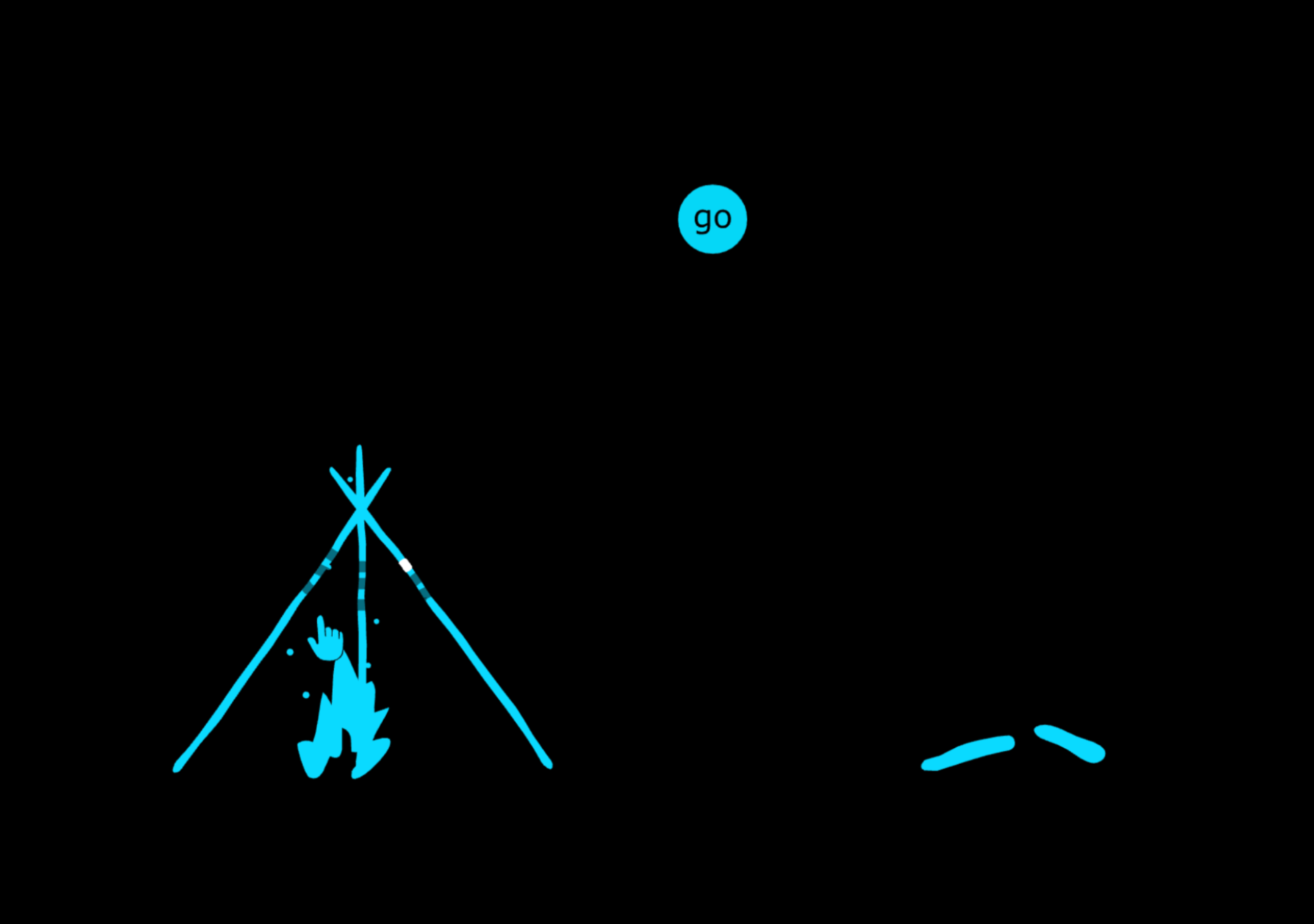
Cheryl L’Hirondelle, nikamon ohci askiy (songs because of the land) (detail), 2008, access restored 2023. Website.
On December 31st, 2020, Flash software (1996-2020) was pulled from the digital universe, taking down with it most of the art that relied on the plugin to exist. Even well-funded projects such as the National Film Board of Canada’s ground-breaking interactive digital documentary, HIGHRISE: Out of My Window, were too expensive and complex to convert. Much digital artwork from the past thirty some years is lost to changing technology. This has a devastating effect on our capacity to know and experience our heritage. The first decades of digital art making in Canada saw a flourishing of artists from diverse communities: Indigenous, BIPOC, feminist, Queer, diasporic. Hence, the heritage we are losing is that which connects us to communities neglected by traditional art histories and institutions. The task of preserving and restoring digital born and web-based cultural history is both urgent and daunting. The VML’s first digital born project brought together an interdisciplinary team from Art History and Art Conservation, Film and Media, The School of Computing, The Centre for Advanced Computing (CAC), the Agnes Etherington Art Centre, and Queen’s Library and Archives. We examine the problem of recovering and protecting digital art in Canada with the goal of building a foundation for longer-term interdisciplinary digital culture research (e.g., The Future of Digital Media Histories; ELMA). This project be one of few digital culture preservation initiatives around the world and the first of its kind in Canada in decades. Will Digital Art Have a Digital Future was funded by Queen’s University VP (Research) Wicked Ideas initiative.
Media Cosmologies: an intergenerational conversation on art, technology, and transmission with Cheryl L’Hirondelle and Callum Beckford 
Since the mid-1990s when world wide web first swung into public view, the net art works of Cheryl L’Hirondelle (Cree/Halfbreed; German/Polish) have explored and articulated the radical possibilities of nêhiyawin (Cree worldview) within the emergent, evolving landscape of digital culture.Among Turtle Island’s earliest adopters of the web as an artistic medium and most cogent theorists of its significance as a space of cultural self-determination and survivance, L’Hirondelle has created and co-created a body of artworks and texts that are crucial not only to understanding the full histories of media art and the internet, but also to imagining their futures –– Isi-pîkiskwêwin-Ayapihkêsîsak (Speaking the Language of Spiders, with Ahasiw Maskegon-Iskwew, 1996),Dene/Cree ElderSpeak: Tales of the Heart and Spirit (with Ahasiw Maskegon-Iskwew, 1998), treatycard (2004), Horizon Zero 17: TELL (2004), and wêpinâsowina (2005), among others.
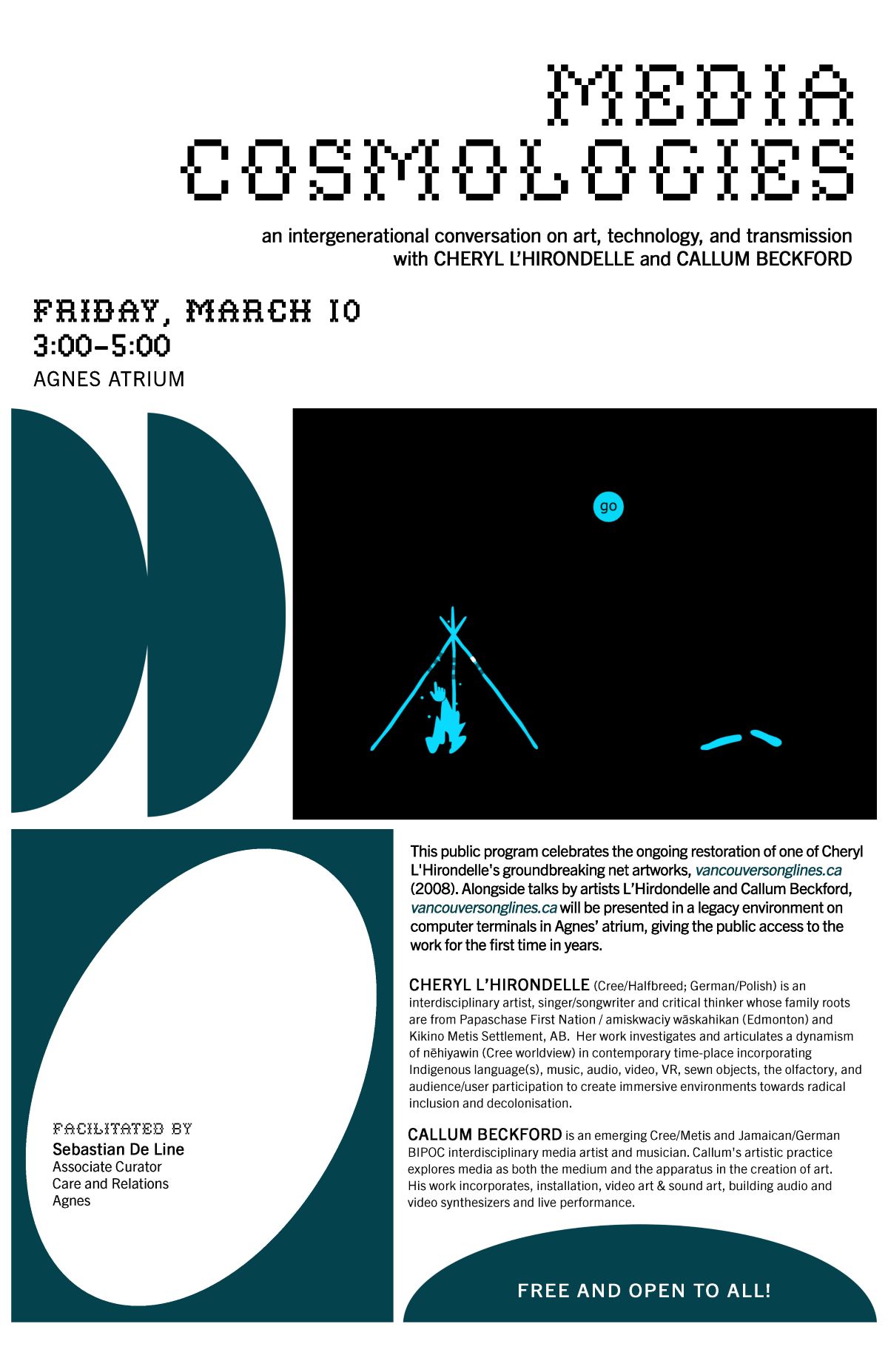
This event was part of "Will Digital Media Have a Digital Future?". This public program celebrates the ongoing restoration of one of these projects, vancouversonglines.ca (2008). Alongside talks by artists Cheryl L’Hirdondelle and Callum Beckford, vancouversonglines.ca will be presented in a legacy environment on computer terminals in Agnes’ atrium, giving the public access to this work for the first time in years.
Dorit Naaman: Jerusalem, We Are Here 
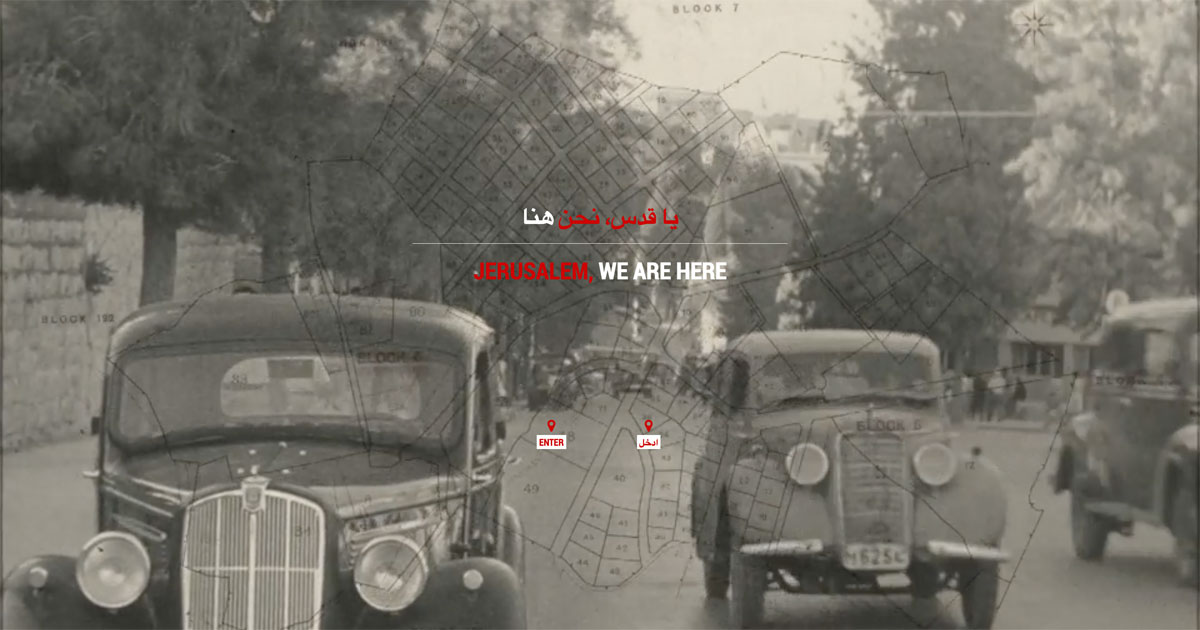
Dorit Naaman, Jerusalem, We Are Here (detail), 2016. Interactive documentary
Jerusalem, We Are Here is an interactive documentary that digitally brings Palestinians back to the Jerusalem neighbourhoods from which they were expelled in 1948. Focusing primarily on the neighbourhood of Katamon, Palestinian participants and their descendants probed their families’ past, and engaged with the painful present. In this documentary, visitors are able to choose from several narrated routes and move through streets using a combination of Google Street View-style imagery, archival photographs, audio recordings, and video clips.
In this project, we attempted to archive Jerusalem, We Are Here using web archiving tools such as Conifer and Webrecorder. These tools play an important role in preserving digital culture, as they allow users to capture and replay web experiences. While they are valuable in many ways, our attempt to archive this documentary revealed several limitations, especially when it comes to dynamically loaded content, external APIs, and interactive web systems.
The first set of issues appeared while using Conifer. At the beginning of the capture process, the tool was unable to properly load certain clickable image elements on the website that were used as hotspots. During the live capture, visible error messages appeared indicating loading failures for hotspot image files. This suggested that Conifer was attempting to retrieve image assets required for interaction with the documentary, but it could not properly access them.
The more serious problem became clear only after the capture was complete. When replaying the archived documentary offline, Conifer failed to display the Google Map entirely. Instead of an interactive map, there was only a blank space where a central feature of the documentary should have been. Because movement through the site depends partly on this mapping system, the absence of the map significantly changed the experience of the work and reduced the usefulness of the archived version. Based on these observations, it seems that Conifer can only preserve map content when it is already fully embedded into the webpage during the initial loading process. Once content depends on retrieving data from external services, databases, or APIs, the tool struggles to capture it.
We also tested Webrecorder and encountered a different kind of issue. In our case, the archived site often appeared only as a blank screen during replay. Although the archive file itself existed, none of the actual content was visible or functional. From what we observed, this is likely because the website relies heavily on dynamic content, especially map systems and externally loaded materials. As a result, the recording may preserve the shell of the site, while failing to preserve the interactive systems that make the project usable.
At this point, it seems that creating a fully functional offline version of a site such as Jerusalem, We Are Here is difficult with standard web archiving tools. These tools can preserve parts of the experience, but not always the full interactive structure of the project. From this, we could conclude that Conifer and Webrecorder cannot reliably record parts of websites that depend on real-time data or constant connection to external services. This creates a problem for web archiving, especially because many digital projects now rely on embedded maps, third-party platforms, APIs, and scripts that load content dynamically.
Exhibiting Internet Art: Creating and Testing New Approaches to Display 
Canada’s early internet artists helped define the cultural possibilities of the web, yet many of their works remain inaccessible today due to technological obsolescence and a lack of established display practices. This project develops new curatorial and conservation approaches to revive net art from the 1980s–2000s, ensuring its sustainable access and reconnecting it with contemporary audiences.
VML Co-Director Jen Kennedy and Post-Doctoral Fellow Mikhel Proulx received a Social Science and Humanities Research Council of Canada Insight Development Grant to investigate how historical internet art—or net art—can be more effectively accessed and exhibited. Net art represents a vital yet under-exhibited dimension of Canadian contemporary art history. Created with now-obsolete technologies, many early internet artworks are difficult to install and interpret in today’s exhibition contexts. This pilot project, developed through the Vulnerable Media Lab, addresses this gap by testing conservation and curatorial strategies for restoring and displaying historical net art in museums and galleries that lack specialized technical resources.
The project is organized around four objectives: to survey existing display methods; to assess their challenges for curators, artists, and installers; to test adapted or novel strategies for exhibition; and to make a selection of net artworks newly accessible. These case studies will form the foundation for renewed scholarly and public engagement with an important but overlooked chapter of Canadian media art.
The project’s outcomes will include both scholarly and public writing, and the groundwork for a major exhibition at the Agnes Etherington Art Centre. By reactivating works long absent from public view and developing accessible exhibition methodologies, this research contributes to sustaining Canada’s digital cultural heritage and expands the pedagogical and curatorial frameworks through which net art can be studied, taught, and experienced.
Rita McKeough, Wave Over Wave 
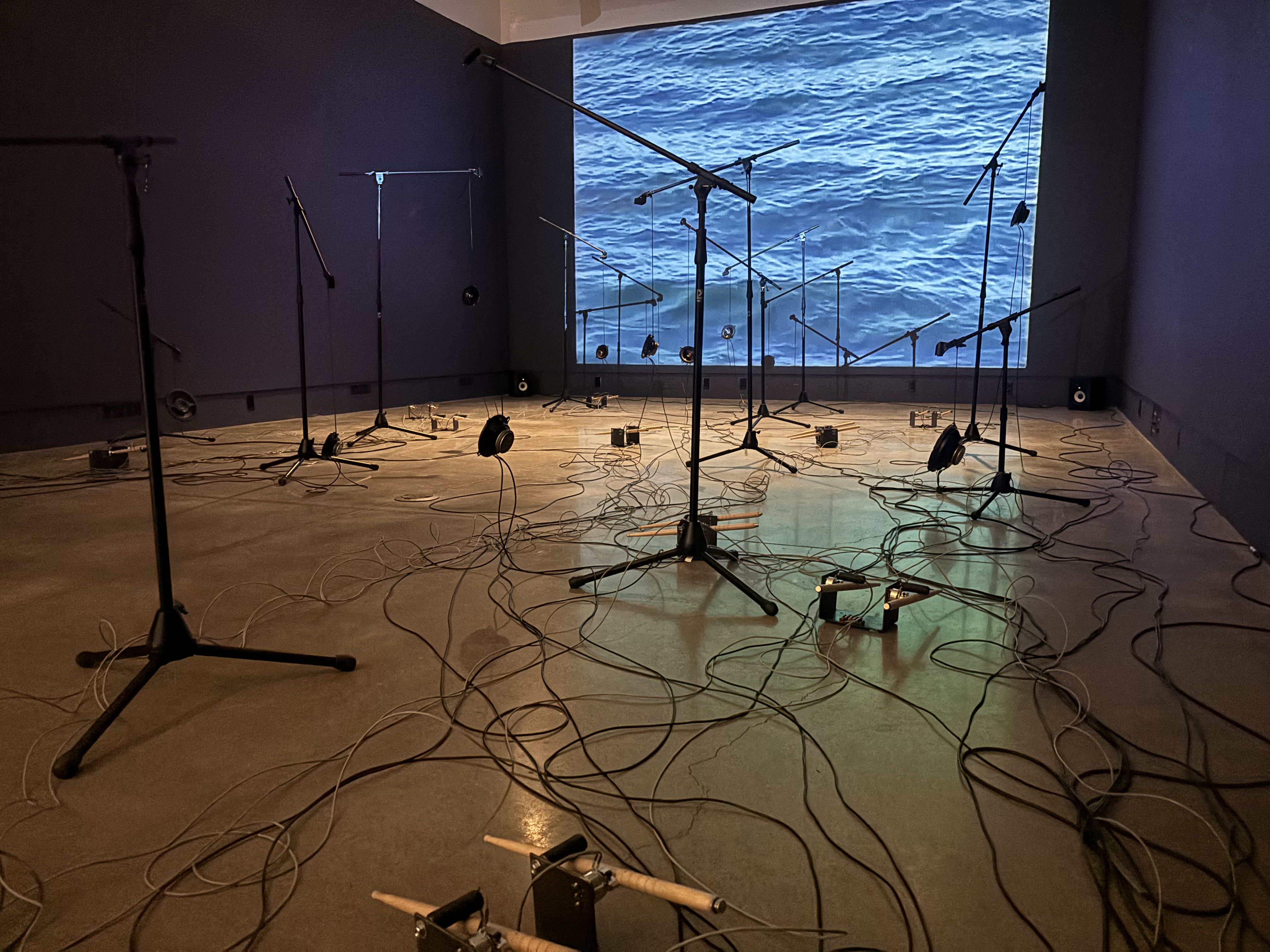
As part of her 2024 residency at Queen’s University, renowned media artist Rita McKeough worked with the Vulnerable Media Lab to restore and present Wave over Wave (2000). Integrating kinetic sculpture, sound, and video, the artwork explores themes of loss, labour, and ecological interconnection. The restoration project bridged conservation, curatorial research, and pedagogy, reflecting McKeough’s feminist and ecological approach to artmaking and the Lab’s commitment to supporting the continued life of historically significant media artworks.
In the autumn of 2024, the Vulnerable Media Lab invited artist Rita McKeough to Queen’s University to restore her complex media installation Wave over Wave (2000). Known for her interdisciplinary practice in sound, performance, electronics, and sculpture, McKeough has been a leading voice in Canadian feminist and ecological art for over fifty years. This restoration enabled a renewed encounter with one of her most technically intricate and emotionally resonant installations. The restoration project addressed the preservation of kinetic, sound, and video elements that had become inoperable since the work’s original installation in Nova Scotia in 2000.
Wave over Wave is a kinetic sound installation in which twenty-four motorized drumsticks beat in rhythmic synchrony with a projected video and multichannel audio composition. Originally developed as a site-specific artwork for the Halifax waterfront, the piece reflects on the human relationship to the sea—its rhythms, its dangers, and its histories of work, migration, and loss. The percussion and vocal soundtrack serve as both memorial and meditation, evoking the presence of those who have lived and died at sea.
The restoration was undertaken at the VML in collaboration with artist-technologist Peter Flemming. Decades after its initial exhibition, Wave over Wave faced substantial conservation challenges: mechanical failure, outdated control systems, and deteriorating audiovisual components. The restoration team worked to recover the original sequencing and physical motion of the drumsticks, while updating the media playback system to contemporary formats. The restored installation of Wave over Wave was presented November 2024 in the Art + Media Lab, where it transformed the gallery into a space of sonic and kinetic encounter, reanimating the rhythms of the sea and the memory of lives connected to it.
Rita McKeough’s residency was made possible by the Queen’s University Vice-Principal Research Visiting Artist-in-Residence Fund and the Postdoc Initiative Fund. It was supported by the Agnes Etherington Art Centre and the Departments of Art History & Art Conservation and Film and Media, and hosted by the Vulnerable Media Lab.
References:
- Bowen, Deanna, ed. Other Places: Reflections on Media Arts in Canada. Toronto; Media Arts Network of Ontario/Public Books, 2019.
- Cook, Sara and Sara Diamond, eds. Euphoria and Dystopia: The Banff New Media Institute Dialogues. Banff, AB: Banff Centre Press, 2011.
- Dekker, Annet and Gabriella Giannachi, eds. Documentation as Art: Expanded Digital Practices. London and New York: Routledge, 2023.
- Dekker, Annet. Collecting and Conserving Net Art: Moving Beyond Conventional Methods. London and New York, Routledge: 2018.
- Engel, Deena and Joanna Phillips. Conservation of Time-Based Media. London and New York: Routledge, 2023.
- Grau, Oliver, Janina Hoth, and Eveline Wandle-Vogt, eds. Digital Art Through the Looking Glass: New Strategies for archiving, collecting, and preserving in Digital Humanities. Donau: Edition Donau-Universität Krems, 2019.
- Loft, Steven and Kerry Swanson eds. Coded Territories: Tracing Indigenous Pathways in New Media Art. Calgary: University of Calgary Press, 2014